
Wholesale & distribution
Onyii Nwa Imo
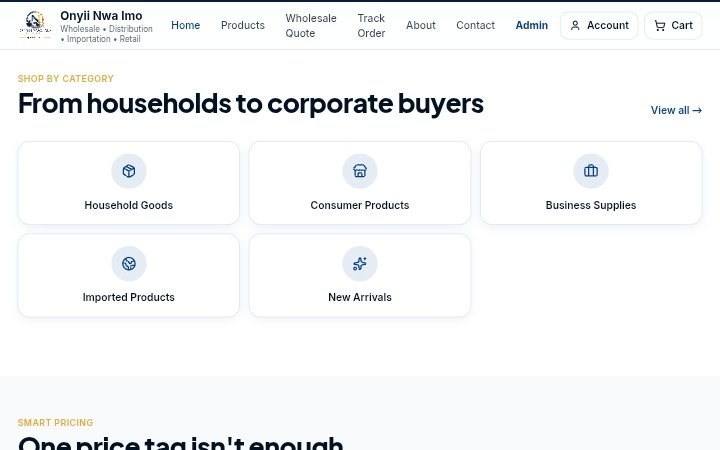
A wholesale and retail business quoting two different price levels by hand over WhatsApp. We built a platform where retail and wholesale pricing is handled by the system, with a catalogue and order tracking.
The brief
Onyii Nwa Imo sells both to individual buyers and to resellers who buy in volume. Two customer types, two price levels, one person holding the whole thing in their head.
Every enquiry meant re-sending photos, remembering which price band the buyer belonged to, and tracking the resulting order in a chat thread that quickly scrolled out of reach.
What was actually going wrong
Dual pricing done by memory is a slow leak. Occasionally a reseller is quoted retail and walks away; occasionally a retail buyer is quoted wholesale and the margin disappears. Neither shows up in any report, because nobody is measuring the quotes that went wrong.
The bigger constraint was capacity. When only one person can answer "what does this cost for you", the business can only grow as fast as that person can reply to messages.
The goal was to move pricing rules out of one person's head and into a system, so buyers can serve themselves up to the point where a human genuinely adds something.
Before and after
| Area | Before | After |
|---|---|---|
| Pricing | Quoted per conversation, by memory | Tiered retail and wholesale pricing held by the system |
| Catalogue | Photos re-sent to each buyer | A browsable catalogue with a link to share |
| Orders | Scattered across chat threads | Recorded and trackable |
| New buyer enquiry | Started from scratch each time | Buyer sees the range and prices before asking |
What we built
Tiered pricing as a system rule
Retail and wholesale pricing are held per product and applied by buyer type rather than recalled per conversation. The rule is written once and applied consistently every time.
A real catalogue
Products, categories and availability live in one place, so a buyer can browse the range instead of waiting for photos to be forwarded. The catalogue is a link that can be shared into any conversation.
Order tracking
Orders are recorded against the buyer with their current status, so "where is my order" has an answer that does not require scrolling a chat history.
WhatsApp kept in the flow, deliberately
Buyers here negotiate. Rather than fighting that, the platform hands the conversation to WhatsApp at the right moment — with the product and price already attached, so the chat starts from a shared fact instead of a question.
Decisions worth explaining
Not a checkout-first store
A conventional cart-and-pay flow would not match how wholesale actually trades. The platform presents the catalogue and pricing, then routes to a real conversation for the order.
Pricing rules the owner can change
Prices move. If changing one requires a developer, the site becomes wrong within a month and stops being trusted. Pricing is editable by the business.
Light pages, small images
Buyers browse on mobile data. Every image is compressed and sized for phones, because a catalogue that takes too long to load is a catalogue nobody scrolls.
Where it stands now
Pricing logic now lives in the platform rather than in one person's memory, so the correct price band is applied consistently.
Buyers can see the range and what it costs them before they start a conversation, which means conversations start further along.
Orders are recorded rather than reconstructed from chat. The platform is live at onyiinwaimo.com.
What we would tell the next client
- Model the way the business actually trades, not the way e-commerce templates assume it trades.
- Anything that changes weekly must be editable by the owner.
- WhatsApp is not a fallback here; it is the channel. Design for it on purpose.
Recognise your own business here?
Bring the process that costs you the most time. We will tell you what it would take to fix it.
Book a consultation